

Table of Contents
How to Open a Nurse-Owned Practice in Colorado
You've done the math in your head more than once. A few injectable appointments on your day off, on your own schedule, in your own space, and suddenly the shifts you pick up out of obligation start to look optional. Colorado is one big, busy aesthetics market, from Denver out to the mountain towns, and it's the kind of place where a nurse with real skill and a good chair doesn't stay a secret for long. (Already run your own practice? Skip ahead, there's a section below built specifically for you.)
The thing that stops most nurses in Colorado was never the clinical work. You already do harder things on a Tuesday than a first tox or IV appointment will ever ask of you. What stops people is everything around it, the ownership rules, the medical director, the setup, all sitting there as one giant undefined to-do. So let's take it in order, starting with the question every Colorado nurse asks first.
Can a nurse own an aesthetics, wellness, or functional health practice in Colorado?
Not the clinical side, and Colorado is strict about it. Colorado enforces the corporate practice of medicine doctrine strictly, and the doctrine determines who may own the entity that delivers care. Colorado's statute defines a corporation to include a limited liability company, so forming an LLC doesn't get you around it. A registered nurse may not own an entity that delivers medical services. (C.R.S. 12-240-138; C.R.S. 12-240-121(1)(g).)
What works instead is a two-entity structure, and it's the same model Five Square already runs in Texas. Colorado law allows the clinical entity to be owned by a physician or by an APRN with full practice authority, and with Five Square it's physician-owned. Alongside it sits a business you own, connected by a management services agreement priced at fair market value. The management fee may not be a percentage of clinical revenue, and Colorado treats fee division as its own violation.
Note one Colorado quirk while you're structuring: Colorado doesn't register a professional limited liability company as a separate entity type, so an APRN-owned clinical entity uses a standard LLC.
The disclosure rule that doesn't apply when you do the work
HB25-1024 took effect in 2025 and added a triple disclosure requirement whenever medical-aesthetic services are delegated to an unlicensed person: a posted notice at the location, a notice on the website and in advertising, and a signed informed-consent disclosure retained for at least seven years.
Here's the part worth reading twice. Those disclosure duties don't apply when the RN performs the service, because an RN is a licensed provider. A practice built around licensed nurses doing the clinical work stays outside the disclosure regime entirely. A practice that delegates to unlicensed staff picks up three ongoing obligations and a seven-year retention duty.
No on-site rule, and no credential asymmetry
Colorado is refreshingly simple here. There's no on-site requirement under either framework and no physician-versus-APRN split, because the Medical Board's delegation rule doesn't apply to registered nurses at all. RN services are governed by the Nurse Practice Act instead. No Colorado statute or Board of Nursing rule requires the physician to be on the premises while an RN performs a delegated medical function.
The asymmetry in Colorado is RN versus unlicensed staff. For an unlicensed delegatee, the provider has to be on the premises unless that person acts under specific detailed written protocols with adequate written emergency protocols in place.
Colorado doesn't use the statutory term good faith exam. The prescriber establishes a bona fide practitioner-patient relationship, and prescribing may not be delegated. Telehealth is permitted with no prior in-person visit required, though an online questionnaire on its own isn't acceptable. Standing orders can carry repeat treatments provided the patient's health status is unchanged.
One more for anyone bringing on an APRN: an APRN may not receive a financial benefit for prescribing.
How the practice and the money work in Colorado
Once nurses hear "two entities," the next question is always about the money. Fair question. Here's how it works, in order.
There are two businesses. The clinical practice is physician-owned. It's the entity that delivers medical care, holds the merchant account, and gets paid when a patient checks out. Your business is an LLC you own, and it runs everything else: your brand, your space, your marketing, your schedule, and your staff. A written management services agreement connects the two and spells out every dollar that moves between them.
Where a patient's payment goes
- Your patient pays the practice. Card payments settle into the physician-owned clinical entity, because medical revenue has to be earned by the licensed entity.
- Your funds are tracked on their own. Revenue from your patients sits in an account dedicated to your practice. It's never pooled with another nurse's, and you can see it.
- Your funds move to your LLC on a set schedule. Transfers follow the written agreement, so you know when money lands and why.
- You run your business. Your LLC pays your expenses and keeps your profit. Five Square doesn't take a cut of your revenue.
Why part of your membership goes to a physician practice
In Colorado, a fixed portion of your monthly membership is paid to the physician practice that holds the clinical entity and provides your medical directorship. You'll see it listed as its own line. It's a flat amount, and it never changes based on how much you bring in, because a percentage of clinical revenue is exactly what Colorado law steers clear of.
Managing the funds flow also takes real accounting work every month, so practices on this structure carry a small monthly administrative fee. Your rep will walk you through every line before you sign anything.
What you own, and what Five Square carries
You own your LLC, your brand, your patient relationships, your schedule, your staff, your marketing, and your profit after expenses. What you don't own is the clinical entity itself, and in Colorado that has to sit with a licensed owner.
Five Square carries the physician-owned clinical entity, the medical directorship, the written protocols and orders, the legal work behind the structure, and the compliance guidance that keeps it clean while you operate. Separate entities, separate books, separate accounts, and an agreement your day-to-day actually matches. That's what regulators look for, and it's already built, so you aren't paying healthcare counsel to assemble it from scratch.
How Five Square actually gets you started
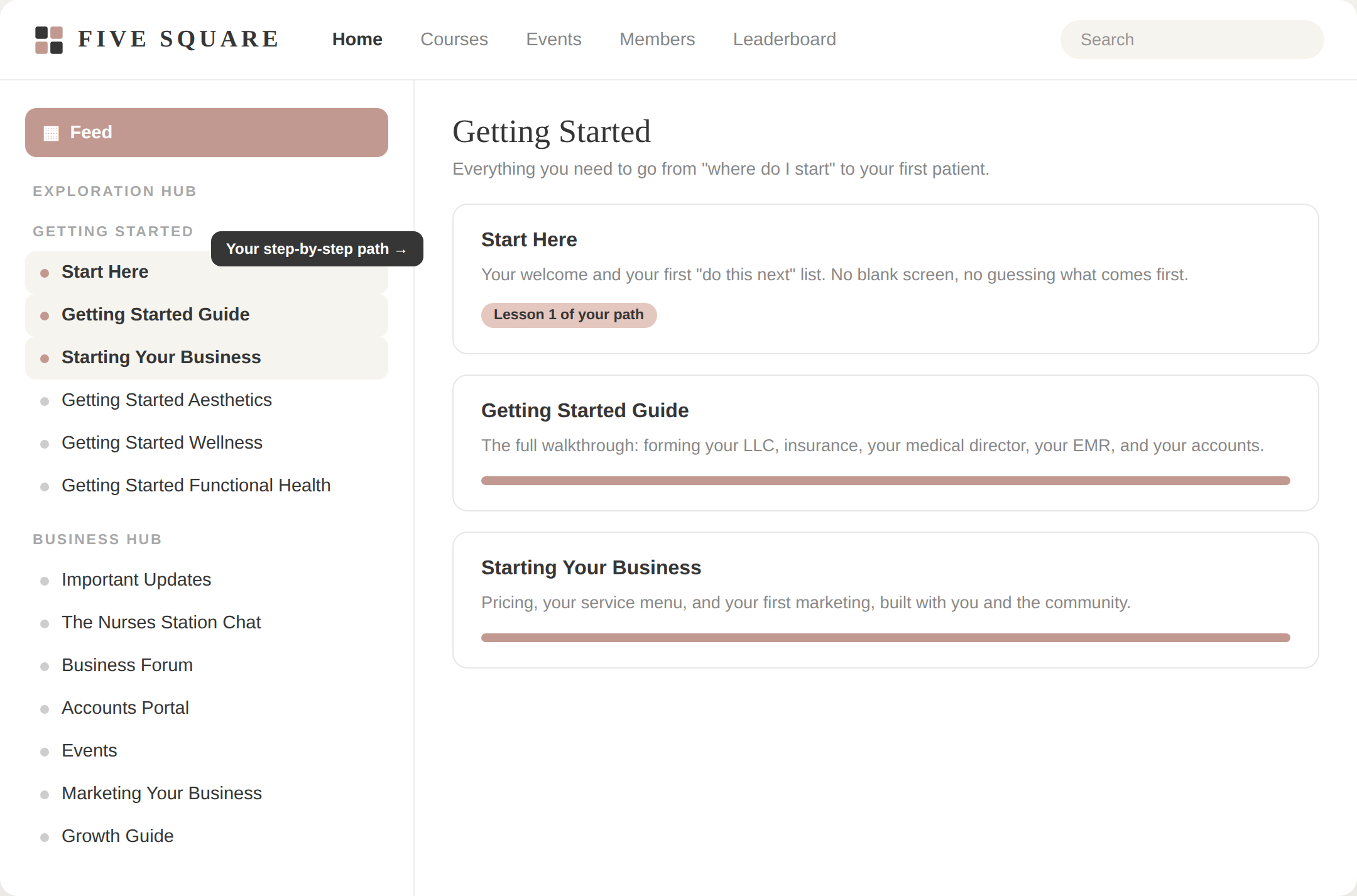
The whole thing lives in one place: the free Five Square Nurse Community app. Your medical oversight, the step-by-step training, your pharmacy and vendor accounts, and the entire community of nurse business owners are all in there. You can open it between patients, on a lunch break, or on the couch at 9pm, and pick up right where you left off.
When you join, you're not handed a login and wished good luck. There's a Getting Started path that puts the order of operations right in front of you, so the mountain becomes a checklist.
You pick your lane, or combine them. Five Square supports three:
- Aesthetics. Tox and dermal filler, the core of a nurse-injector practice, with room to add more as you train.
- Wellness. IV therapy and vitamin injections. Low startup, very mobile-friendly, and a natural add-on to aesthetics.
- Functional Health. Peptides, lab work, and whole-person care for nurses who want longer-term, relationship-based patients.
You bring the nursing license and the nerve. We bring the medical director, the compliant Colorado setup, the training, member pricing on products, marketing help, and weekly live calls with experts and other nurse owners, so you're never stuck guessing alone.
And every Five Square member, brand new or already established, gets instant on-demand Good Faith Exams for $19.99 each, a price we subsidize because we believe in nurse success. A walk-in can be cleared in about a minute, seven days a week, and the exam paperwork lands right in the patient's chart, which is exactly what a state board wants to see.

You start before you feel ready, and that's the point
Most programs make you wait. Watch every module, sit through every call, and someday you finally see a patient. By then half the people who started have lost momentum. Five Square runs the other way: you start your practice while you're still finishing the training, because the training sticks when there's a real patient on next week's calendar.
Kayla, an ER nurse in North Carolina, had never injected anyone when she joined. She watched the videos, took notes, and set a goal of 30 people in 30 days. Here's the advice she'd give a nurse who's scared to start:
"Believe in yourself, even when you don't know how to do something. Figure it out. The clinical knowledge from your nursing career is more than enough to get started, and there's a community of people around you who want to help. Do it scared."
- Kayla, ER nurse
She launched April 4. Her first month: 46 appointments, 28 good-faith exams, and $10,320 in revenue, run out of a single room inside a salon she'd been a client at for years. That's one real month from one real nurse, not a typical result and not a promise, and your market and hours are your own. The point is she was exactly where you are, never-done-this-before, and she started anyway.
Does it actually work once you launch?
Getting launched is step one. What you really want to know is whether it works after that. Here's the honest picture, numbers included, because income claims in this industry deserve a skeptical read.
Results vary, and they depend on things no membership controls: your market, your hours, how long you've been at it, how consistently you market. As practices mature, some established members report months in the $10,000 to $20,000 range. Individual results vary widely. Some land higher, some lower, and nobody here will promise you a number.
What's more useful is the math underneath, which is public. Neurotoxin appointments bring in $200 to $600. A syringe of filler runs $500 to $800. IV sessions run $150 to $350. Functional health consults run $150 to $300, often with patients coming back monthly. At those prices, two to four appointments a month would cover the $899 membership before product costs, and everything past that is the business growing. Want to see it with your own pricing? Run your numbers in the Five Square membership earnings calculator.
The nurses say it better than a revenue range does:
"As a single mom, the thought of risking my stable nursing income terrified me. Starting my aesthetics business part-time gave me confidence and security."
- Kiley D., BSN, RN-C"I'm never going back to floor nursing. I didn't think making this income while still making it to all my kids' activities was even possible. Five Square made it easy."
- Lindsey K., RN
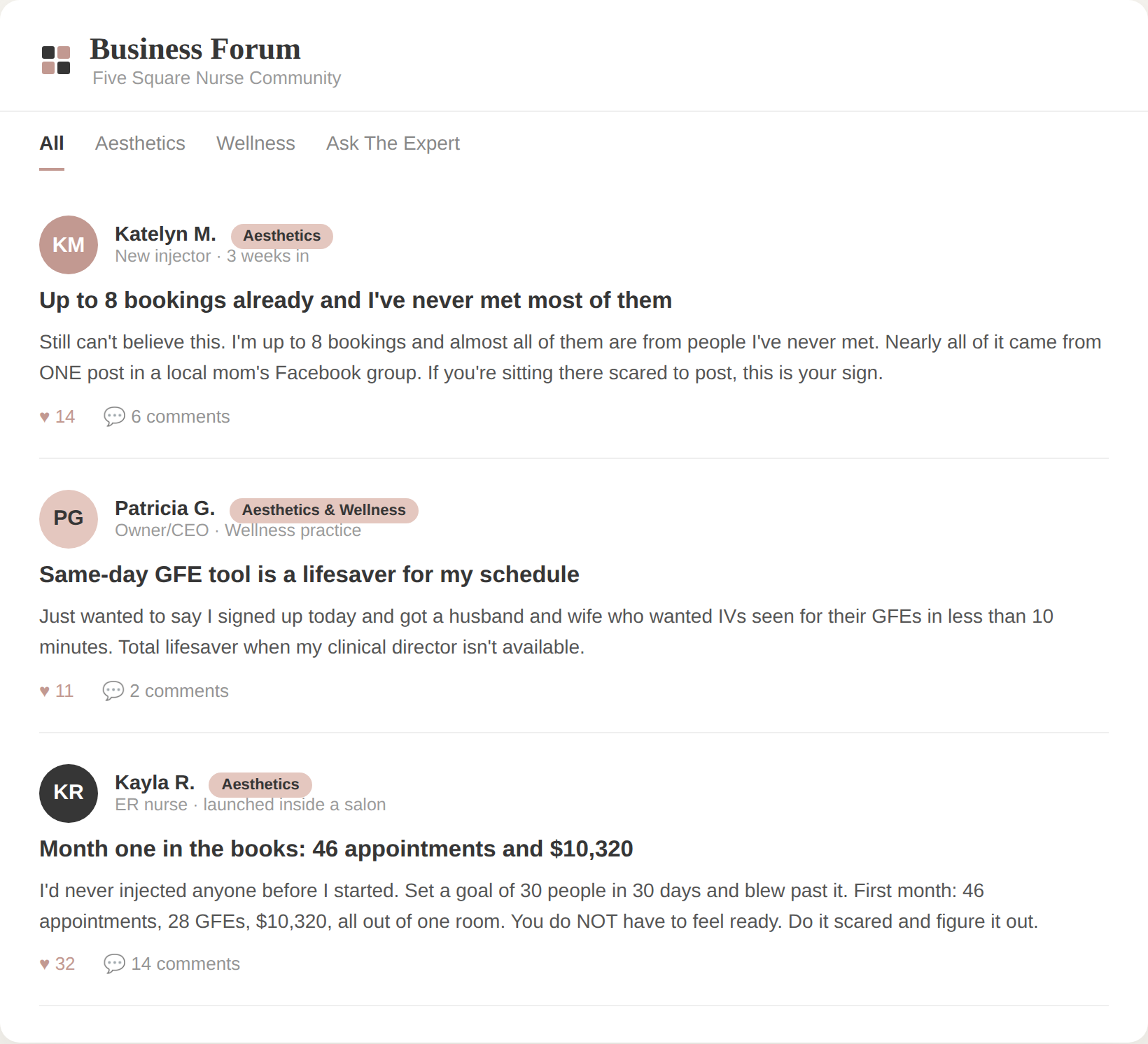
Inside the community, the wins show up in real time. A nurse a few weeks into her launch posted she was already up to eight bookings, nearly all of it from one post in a local mom's Facebook group. Another saw a husband and wife for their good-faith exams in under ten minutes using the same-day exam tool when her director wasn't free. Scroll the forum any week and it's full of small wins like these.
The Google rating sits at 4.8 stars, and the reviews keep naming the same things: the setup help, the medical director, the training, and a team that answers when you're stuck.
Already run a practice in Colorado? There's a membership for that too
Not every nurse reading this is starting from scratch. Plenty of you already run your own practice and already pay for a medical director somewhere. If that's you, a lot of what's above is stuff you sorted out a while ago, and Five Square has a leaner membership built for exactly your spot. In Colorado, you can join whether you're just starting out or already running a practice.
It's called the Established Nurse Membership. It's $799 a month, month to month, no annual lock. You get a medical director who's actually engaged, a compliant structure in Colorado, vendor and product pricing, the Five Square Nurse Community, and those instant on-demand Good Faith Exams at $19.99 each, a price we subsidize for our members because we believe in nurse success. There's no new-injector training folded in, because you don't need it and shouldn't pay for it. If you ever want the full education stack later, you can add it.
Here's the honest pitch. Most established practices are either paying $1,500 to $5,000 a month for a director who's genuinely involved, or a few hundred for one who signs protocols and disappears, which is its own risk when a board comes asking. For most nurses, $799 all in beats both, on price and on what you actually get. Tell us what you're paying now and we'll show you the side by side. No pitch, just the math.
What it costs, and the catch nurses look for
For a nurse starting out, membership is a flat $899 a month for one tier, $1,199 for two, $1,499 for all three, on a 12-month term. Startup beyond that is lighter than people expect: a starter tox order, insurance that runs well under most nurses' guesses, and the products you actually use. No revenue share, ever. (Already have a practice? The Established Nurse Membership above is $799 a month, month to month.)
That's usually the moment the skeptical part of your brain asks where the catch is. Fair. So, plainly: you own your LLC, your brand, and your patient relationships. The clinical entity is physician-owned, because Colorado requires it, and Five Square already built it. Five Square doesn't take a cut of your revenue, and if a discovery call turns up that the honest answer for you is 'not yet' or 'start smaller,' the team will tell you that too.
Colorado-specific costs to budget for
In Colorado the structure itself is the big-ticket item: a physician-owned clinical entity, a management services agreement priced at fair market value, and the accounting to keep the funds flow clean. Building that on your own means hiring healthcare counsel and finding a physician willing to own the clinical side. With Five Square it's already built, and what it costs you shows up as the fixed medical directorship portion of your membership and the admin fee covered above. Budget separately for your own LLC filing with the Colorado Secretary of State, insurance, and your starting product.
So, where do you actually start in Colorado?
You book the call. That's genuinely it. Not a six-month research project, a 15-minute conversation about your license, your goals, and what launching (or leveling up) in Colorado would look like for you. Whether you're brand new or already running a practice, the whole reason Five Square exists is so you're not doing the hard parts alone.
Common questions about starting a practice in Colorado
Why can't I own my practice outright in Colorado?
Colorado enforces corporate practice of medicine strictly, and its statute defines corporation to include an LLC, so the entity form doesn't change the answer. A registered nurse may not own the entity that delivers medical services. The workable structure is a licensed-owner clinical entity plus a business you own, connected by a management services agreement at fair market value. With Five Square, the clinical entity is physician-owned and already set up.
Where does my patient's payment go in Colorado?
To the physician-owned clinical entity first, because that's the licensed entity allowed to earn medical revenue. It's tracked in an account dedicated to your practice, never pooled with anyone else's, and transferred to your own LLC on the schedule set in your written agreement.
Why is part of my membership paid to a physician practice?
That's the fixed fee for the physician-owned clinical entity and your medical directorship. It's a flat monthly amount, never a percentage of your revenue, and your rep will show you exactly how it appears on your membership before you sign.
Does the HB25-1024 disclosure rule apply to my practice?
Only if you delegate medical-aesthetic services to unlicensed personnel. The three disclosures, posted notice, website and advertising notice, and signed consent retained seven years, don't apply when a licensed RN performs the service.
Can a registered nurse own a med spa in Colorado? Not the clinical entity. You can own the business LLC that runs the practice, and Five Square provides the physician-owned clinical entity it works alongside.
Do I need a medical director for aesthetics in Colorado? Yes. Colorado requires oversight for medical aesthetic services, and every Five Square practice includes a medical director as part of the membership.
Can a nurse do Botox in Colorado? Yes, within a compliant setup and with the oversight Colorado requires. The question is rarely whether a nurse can do the work; it's whether the practice around it is set up right.
I already run a practice in Colorado. Can Five Square still help? Yes. The Established Nurse Membership is built for nurses who already have a practice: $799 a month, month to month, with a medical director, a compliant structure, vendor pricing, and $19.99 on-demand Good Faith Exams. No new-injector training you don't need, and no annual lock.
How much are Good Faith Exams? For Five Square members, simple Good Faith Exams are $19.99 each, on demand, seven days a week, a price we subsidize because we believe in nurse success. One exam can clear a patient for several treatments at once, and the documentation attaches right to the patient's chart.
Is Five Square available in Colorado? Yes. Colorado is open for both new and established memberships. A discovery call is the fastest way to talk through your timeline and your goals.
How much does it cost to start? For a new nurse, membership is $899 a month for one tier, and startup beyond that (a tox order, insurance, products) is lighter than most nurses expect. If you already run a practice, the Established Nurse Membership is $799 a month, month to month. No revenue share either way.
