

Table of Contents
How to Open a Nurse-Owned Practice in New York
You've done the math in your head more than once. A few injectable appointments on your day off, on your own schedule, in your own space, and suddenly the shifts you pick up out of obligation start to look optional. New York has more injectors per square mile than anywhere in the country, and still the Hudson Valley, the Southern Tier, and half of Long Island are underserved. The market is enormous. It's also the most heavily lawyered one you'll ever open in. (Already run your own practice? Skip ahead, there's a section below built specifically for you.)
The thing that stops most nurses in New York was never the clinical work. You already do harder things on a Tuesday than a first tox or IV appointment will ever ask of you. What stops people is everything around it, the ownership rules, the medical director, the setup, all sitting there as one giant undefined to-do. So let's take it in order, starting with the question every New York nurse asks first.
Can a nurse own an aesthetics, wellness, or functional health practice in New York?
Not outright. New York enforces the corporate practice of medicine through its professional entity statutes. A business that provides medical services has to be a professional service corporation, a PLLC, or a registered LLP, and every owner has to be licensed in the profession the entity practices (Bus. Corp. Law §1503; Ltd. Liab. Co. Law §1203). An unlicensed person practicing medicine, or a business doing it through hired clinicians, is a class E felony (Educ. Law §6512). The Office of the Professions puts it plainly on its nursing page: a business that isn't authorized by New York law to provide medical or nursing care can't hire nurses to provide nursing services. So an RN-owned LLC that sells tox is off the table. Nurses do run practices here, through a structure that's more involved than in a full-practice-authority state: a physician-owned professional entity for the clinical work, a management company the nurse owns for the business side, and a fixed management fee, because fee-splitting is professional misconduct (Educ. Law §6530(19)).
The New York rule that catches almost everybody
Standing orders don't work for injectables. An RN in New York executes medical regimens prescribed by a physician, NP, or PA (Educ. Law §6902(1)), and the Office of the Professions limits non-patient-specific orders to a short list: immunizations, anaphylaxis treatment, TB, HCV and HIV tests, opioid overdose treatment, and a few STI screenings. Botox and filler aren't on that list. Every patient needs an order written for that patient by a provider who examined them first. That shapes everything from your scheduling to what your medical director actually does each week. It's also why the initial patient evaluation, which some states call a good faith exam, can't be skipped or batched here: the ordering provider examines the patient and writes the order before you inject. I couldn't find an Office of the Professions statement on telehealth for that evaluation, so treat in-person as the safe default and ask your attorney about video.
On the medical director question, New York is a partial full-practice state. An NP with fewer than 3,600 hours practices under a written practice agreement and written protocols with a collaborating physician (Educ. Law §6902(3)). An NP with more than 3,600 hours may practice without them. That independence came from the 2014 NP Modernization Act, which has a sunset date; Governor Hochul extended it on May 28, 2026 to July 1, 2030. So an experienced NP can own the professional entity and serve as your medical director, with no physician anywhere in the structure. If your director is a physician instead, the physician owns the medical PC or PLLC and you're the management side. An NP director doesn't change the patient-specific order rule; it changes who writes the order.
One surprising fact: forming any LLC in New York, professional or not, triggers a publication requirement. You publish a notice in two newspapers for six straight weeks and file a certificate of publication within 120 days, or the LLC loses its authority to do business (Ltd. Liab. Co. Law §206). In Manhattan that can cost more than the filing itself.
How Five Square actually gets you started
The whole thing lives in one place: the free Five Square Nurses app. Your medical oversight, the step-by-step training, your pharmacy and vendor accounts, and the entire community of nurse business owners are all in there. You can open it between patients, on a lunch break, or on the couch at 9pm, and pick up right where you left off.
When you join, you're not handed a login and wished good luck. There's a Getting Started path that puts the order of operations right in front of you, so the mountain becomes a checklist.
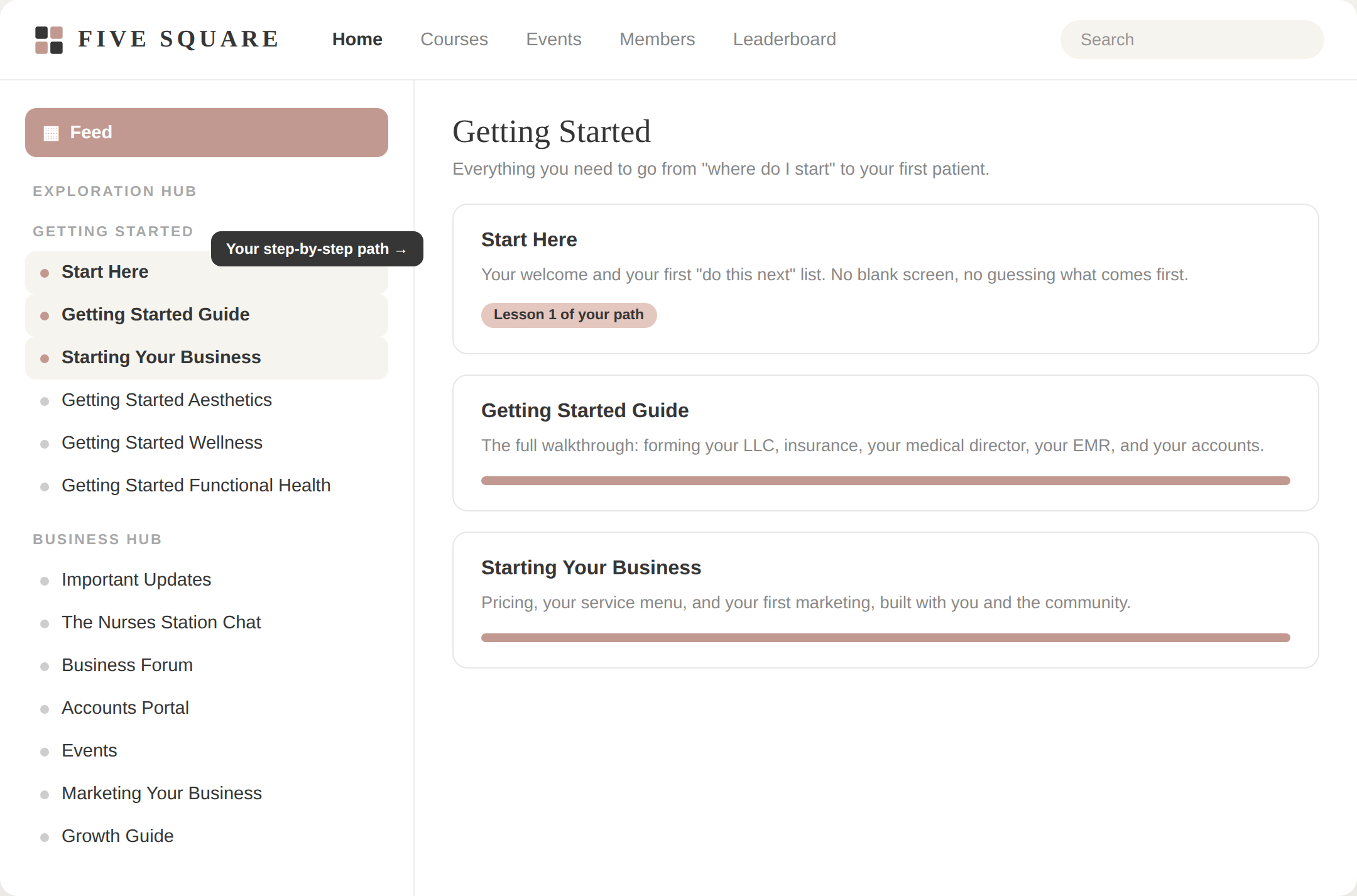
You pick your lane, or combine them. Five Square supports three:
- Aesthetics. Tox and dermal filler, the core of a nurse-injector practice, with room to add more as you train.
- Wellness. IV therapy and vitamin injections. Low startup, very mobile-friendly, and a natural add-on to aesthetics.
- Functional Health. Peptides, lab work, and whole-person care for nurses who want longer-term, relationship-based patients.
You bring the nursing license and the nerve. We bring the medical director, the compliant New York setup, the training, member pricing on products, marketing help, and weekly live calls with experts and other nurse owners, so you're never stuck guessing alone.
And every Five Square member, brand new or already established, gets instant on-demand Good Faith Exams for $19.99 each, a price we subsidize because we believe in nurse success. A walk-in can be cleared in about a minute, seven days a week, and the exam paperwork lands right in the patient's chart, which is exactly what a state board wants to see.

You start before you feel ready, and that's the point
Most programs make you wait. Watch every module, sit through every call, and someday you finally see a patient. By then half the people who started have lost momentum. Five Square runs the other way: you start your practice while you're still finishing the training, because the training sticks when there's a real patient on next week's calendar.
Kayla, an ER nurse in North Carolina, had never injected anyone when she joined. She watched the videos, took notes, and set a goal of 30 people in 30 days. Here's the advice she'd give a nurse who's scared to start:
"Believe in yourself, even when you don't know how to do something. Figure it out. The clinical knowledge from your nursing career is more than enough to get started, and there's a community of people around you who want to help. Do it scared."
- Kayla, ER nurse
She launched April 4. Her first month: 46 appointments, 28 good-faith exams, and $10,320 in revenue, run out of a single room inside a salon she'd been a client at for years. That's one real month from one real nurse, not a typical result and not a promise, and your market and hours are your own. The point is she was exactly where you are, never-done-this-before, and she started anyway.
Does it actually work once you launch?
Getting launched is step one. What you really want to know is whether it works after that. Here's the honest picture, numbers included, because income claims in this industry deserve a skeptical read.
Results vary, and they depend on things no membership controls: your market, your hours, how long you've been at it, how consistently you market. As practices mature, some established members report months in the $10,000 to $20,000 range. Individual results vary widely. Some land higher, some lower, and nobody here will promise you a number.
What's more useful is the math underneath, which is public. Neurotoxin appointments bring in $200 to $600. A syringe of filler runs $500 to $800. IV sessions run $150 to $350. Functional health consults run $150 to $300, often with patients coming back monthly. At those prices, two to four appointments a month would cover the $899 membership before product costs, and everything past that is the business growing. Want to see it with your own pricing? Run your numbers in the Five Square membership earnings calculator.
The nurses say it better than a revenue range does:
"As a single mom, the thought of risking my stable nursing income terrified me. Starting my aesthetics business part-time gave me confidence and security."
- Kiley D., BSN, RN-C"I'm never going back to floor nursing. I didn't think making this income while still making it to all my kids' activities was even possible. Five Square made it easy."
- Lindsey K., RN
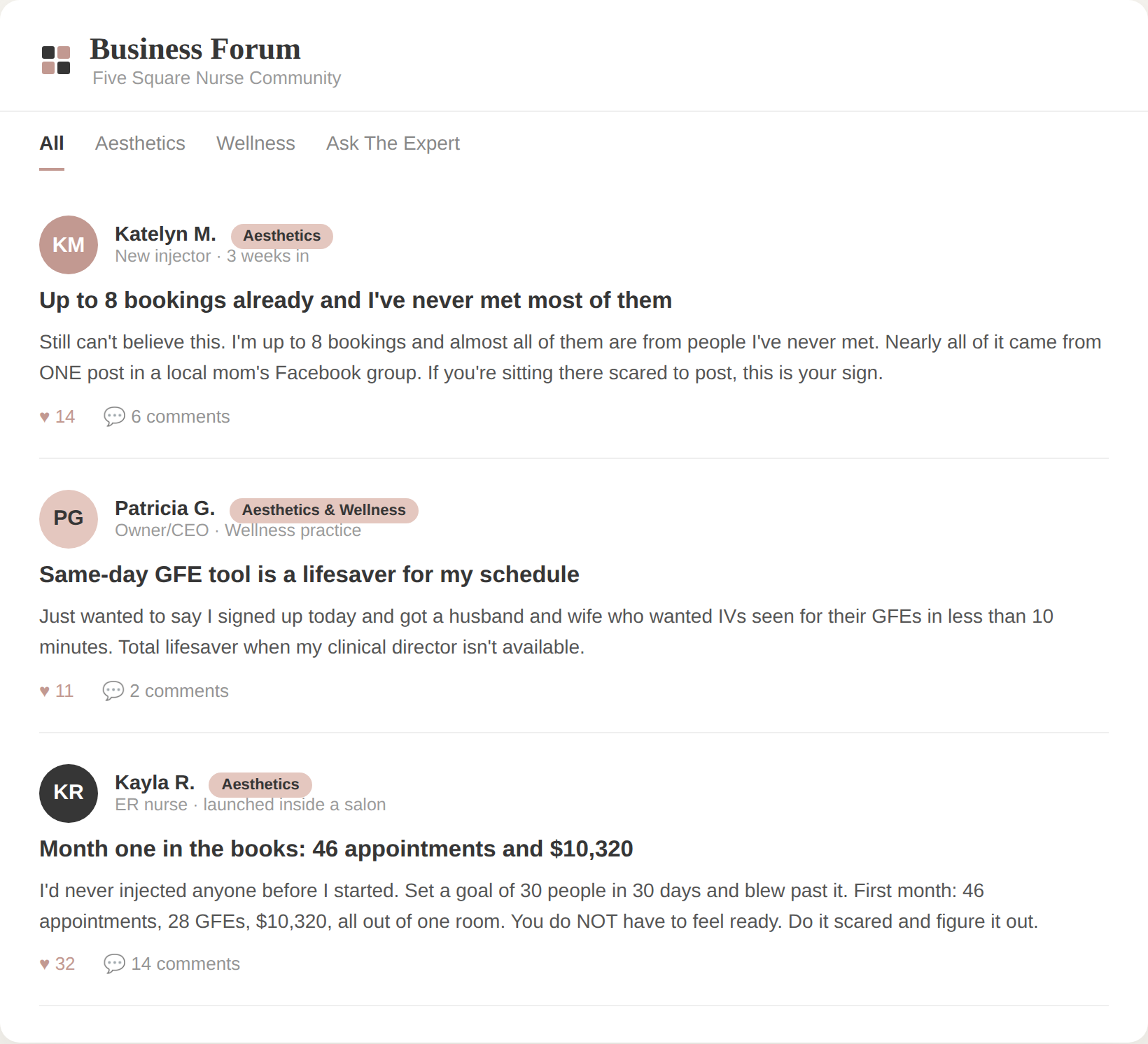
Inside the community, the wins show up in real time. A nurse a few weeks into her launch posted she was already up to eight bookings, nearly all of it from one post in a local mom's Facebook group. Another saw a husband and wife for their good-faith exams in under ten minutes using the same-day exam tool when her director wasn't free. Scroll the forum any week and it's full of small wins like these.
The Google rating sits at 4.8 stars, and the reviews keep naming the same things: the setup help, the medical director, the training, and a team that answers when you're stuck.
Already run a practice in New York? There's a membership for that too
Not every nurse reading this is starting from scratch. Plenty of you already run your own practice and already pay for a medical director somewhere. If that's you, a lot of what's above is stuff you sorted out a while ago, and Five Square has a leaner membership built for exactly your spot. New York is on the Five Square expansion roadmap, and in most new states the Established Nurse Membership opens first, so if you already run a practice, you're likely first in line.
It's called the Established Nurse Membership. It's $799 a month, month to month, no annual lock. You get a medical director who's actually engaged, a compliant structure in New York, vendor and product pricing, the Five Square Nurse Community, and those instant on-demand Good Faith Exams at $19.99 each, a price we subsidize for our members because we believe in nurse success. There's no new-injector training folded in, because you don't need it and shouldn't pay for it. If you ever want the full education stack later, you can add it.
Here's the honest pitch. Most established practices are either paying $1,500 to $5,000 a month for a director who's genuinely involved, or a few hundred for one who signs protocols and disappears, which is its own risk when a board comes asking. For most nurses, $799 all in beats both, on price and on what you actually get. Tell us what you're paying now and we'll show you the side by side. No pitch, just the math.
What it costs, and the catch nurses look for
For a nurse starting out, membership is a flat $899 a month for one tier, $1,199 for two, $1,499 for all three, on a 12-month term. Startup beyond that is lighter than people expect: a starter tox order, insurance that runs well under most nurses' guesses, and the products you actually use. No revenue share, ever. (Already have a practice? The Established Nurse Membership above is $799 a month, month to month.)
That's usually the moment the skeptical part of your brain asks where the catch is. Fair. So, plainly: you own your practice and your patients through your own LLC. Five Square does not take a cut of what you make, and if a discovery call turns up that the honest answer for you is 'not yet' or 'start smaller,' the team will tell you that too.
New York-specific costs to budget for
Articles of Organization for an LLC are $200 with the Department of State, and the biennial statement is $9 every two years. The real cost is the publication requirement under LLC Law §206: two newspapers, six consecutive weeks, then a $50 certificate of publication, and the newspaper rates vary wildly by county (Manhattan is the expensive one). A PLLC also needs a certificate of authority from the State Education Department at $10 per member before filing. If you sell product, New York's state sales tax is 4% plus local rates, so you collect the combined rate for your county.
So, where do you actually start in New York?
You book the call. That's genuinely it. Not a six-month research project, a 15-minute conversation about your license, your goals, and what launching (or leveling up) in New York would look like for you. Whether you're brand new or already running a practice, the whole reason Five Square exists is so you're not doing the hard parts alone.
Common questions about starting a practice in New York
Can my medical director write a standing order for Botox in New York?
No. New York limits non-patient-specific orders to immunizations, anaphylaxis treatment, TB, HCV and HIV tests, opioid overdose treatment, and certain STI screenings. Cosmetic injectables aren't on the list, so each patient needs a patient-specific order from a physician, NP, or PA who evaluated them (Educ. Law §6902(1)). Build your workflow around that from day one; it's the thing New York practices get cited for.
Can a nurse practitioner own the practice in New York?
Yes, if the NP has more than 3,600 hours of practice. Under Educ. Law §6902(3), an NP past that threshold can practice without a written practice agreement, and New York extended that authority through July 1, 2030. The NP forms a professional entity (PC or PLLC) that they own. An NP under 3,600 hours still needs a collaborating physician and written protocols, and an RN can't own the professional entity at all.
Why does everyone talk about the publication requirement?
Because it's a real cost and a real deadline. Within 120 days of forming an LLC or PLLC you have to publish a notice in two newspapers designated by the county clerk for six consecutive weeks, then file a $50 certificate of publication (Ltd. Liab. Co. Law §206). Miss it and the LLC's authority to do business is suspended. In upstate counties it's a few hundred dollars; in Manhattan it can run over a thousand.
Can a registered nurse own a med spa in New York? Not outright. New York enforces the corporate practice of medicine through its professional entity statutes.
Do I need a medical director for aesthetics in New York? Yes. New York requires oversight for medical aesthetic services, and every Five Square practice includes a medical director as part of the membership.
Can a nurse do Botox in New York? Yes, within a compliant structure and with the physician oversight New York requires. The clinical work is rarely the barrier; the structure around it is.
I already run a practice in New York. Can Five Square still help? Yes. The Established Nurse Membership is built for nurses who already have a practice: $799 a month, month to month, with a medical director, a compliant structure, vendor pricing, and $19.99 on-demand Good Faith Exams. No new-injector training you don't need, and no annual lock.
How much are Good Faith Exams? For Five Square members, simple Good Faith Exams are $19.99 each, on demand, seven days a week, a price we subsidize because we believe in nurse success. One exam can clear a patient for several treatments at once, and the documentation attaches right to the patient's chart.
Is Five Square available in New York yet? New York is on the Five Square expansion roadmap, and in most new states the Established Nurse Membership opens first. The fastest way to get the timeline and hold your spot is a discovery call.
How much does it cost to start? For a new nurse, membership is $899 a month for one tier, and startup beyond that (a tox order, insurance, products) is lighter than most nurses expect. If you already run a practice, the Established Nurse Membership is $799 a month, month to month. No revenue share either way.
